Anine Lucia Manum (2026)
Ana Braconnier De León has spent nearly twenty years working on Indigenous Politics and legal struggles in Guatemala. As a researcher at Universidad Rafael Landívar in Quetzaltenango, she works on PluriLand’s Guatemala case study – one of five country cases in the project – together with Rachel Sieder. As the PluriLand project comes to a close, she reflects on what it has meant to her.
Why land, why now
For Ana, the motivation was close to home. “When you live in a society where the majority is Indigenous Peoples, you need to understand the deep dynamics of where you are from,” she explains. Land, she notes, is crucial to politics, economics, and legal issues in Guatemala – which is what drew her to a project built around how communities fight to access and govern the land they have inhabited for generations.
A river, a drought, and a shift in perspective
One memory from the fieldwork has stayed with her. In 2022, Ana and Rachel travelled to Santa María Cahabón, a community near one of Guatemala’s largest rivers — a river dammed by one of the country’s major hydroelectric projects, in a region usually known for good rainfall and fertile soil.
Talking with a community member there, they learned that climate change was drying out the soil, and with it the corn crop – the country’s staple produce. The community had been forced to start importing corn from Mexico.
It was a shock, Ana says, because the region is so fertile. In that conversation, they realised that having access to land and rights to self-determination may not be enough on their own if the land itself can no longer feed the people who depend on it. It gave her, in her words, “a more long-term horizon on where the struggle lies” — in Guatemala, and elsewhere.
Reading twenty years of court cases
PluriLand also changed how Ana works. In the Guatemalan case, the team went beyond looking at litigation and court responses to Indigenous land claims: they also built a database covering the full set of judicial cases that have reached Guatemala’s Constitutional Court. That overall view, Ana says, brought her a more historical perspective and a deeper understanding of how law can be used, interpreted, and reconstructed over time — something she credits to the sheer scale of cases the project let her look at.
Why it matters
Asked what she hopes readers take away from the project, Ana points to something she feels research often overlooks: land itself.
The main focus in her field, she says, tends to be on social and economic rights – their implementation, compliance, and disputes in general – while land itself hasn’t been studied as deeply.
Land, she says, is the basis of life – the basis of the material reproduction of families and communities – and at the same time the main asset in a capitalist society. Ana describes two different worldviews, a capitalistic one and a more communitarian way of inhabiting the world, that are in confrontation, and that confrontation is seen in the courtroom, in litigation, in judicialization. Understanding how those two worldviews come together there, Ana says, is what matters.
Ana Braconnier De León is a researcher at Universidad Rafael Landívar in Quetzaltenango, Guatemala, working on PluriLand’s Guatemala case study alongside Rachel Sieder.
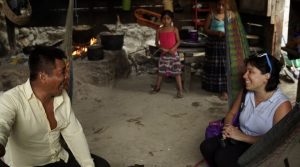
Photo: Ana Braconnier De León