Anine Lucia Manum, Roos de Ruijter (2026)
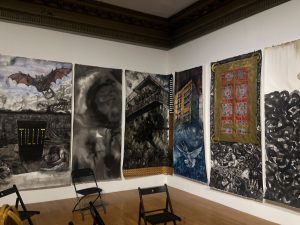
Shwan Dler Qaradaki was born in 1977 in Suleimania, in Iraqi Kurdistan – the Iraqi part of the larger historical and cultural region of Kurdistan – and came to Norway as a political refugee in 1999. He works as a visual artist across drawing, painting, and video, and in his exhibitions Halo of Shame and From Above, he returns directly to the question of what happens to identity when the language that carries it is taken away, and what is left to say it with instead.
After the roundtable, Shwan tells me a story about a friend from Turkey, who lives in Sweden. This friend went his whole life not knowing he was Kurdish. His mother never told him – she was scared that if he spoke Kurdish, or told people he was, he would get picked on and bullied. That fear reflected reality: Kurdish was completely banned in Turkey from 1980 until 1991, when the ban was lifted under President Turgut Özal (Zeydanlıoğlu, 2012). Despite the ban being lifted in the country, there are still social limitations to the practice of the language, and the effect of the ban lingers. Perhaps, we can see this as shame instilled in the mother due to that history and the cultural norms she grew up with. Shwan’s friend found out he was Kurdish when he was eighteen, resulting in him looking for a piece of himself that he never knew he had lost. He is now trying to find his way back to that part of himself by learning the language as an adult, as a route to feel closer to his cultural heritage.
Shwan has made a point of teaching his own children Kurdish – despite, or perhaps especially because, they are growing up in Norway. This year, his children were not able to visit Iraqi Kurdistan because of the war between Iran and the US. The trip itself is not impossible, but the security situation there varies from year to year. For them, the language is a way to stay connected to that part of their heritage, especially as the rest of that part of the family does not reside in Norway. As Shwan puts it: language holds history.
That thread doesn’t just run forward to his children. Shwan still has family living in Iraqi Kurdistan. He checks the news every day, carrying the same unresolved question each time: are they still alive? Sometimes the answer is only silence. He calls these stretches “blackouts,” periods when contact simply stops, with no way of knowing whether it’s a downed phone line or something worse.
That fear is tied to the same history running under everything else here. Kurdish was never formally prohibited in Iraq, but after the Kurdish genocide of the late 1980s – the Anfal campaign, which culminated in the chemical attack on Halabja in 1988 – speaking Kurdish, or being identifiable as Kurdish at all, became dangerous (Kirmanj & Rafaat, 2020). Shwan turned to art to express himself when his language was, as he puts it, taken away from him. Because it was dangerous to show you were Kurdish, people assimilated, and the language began to fade – which is what makes language so critical in the first place. Language is heritage: it anchors a people’s cultural norms and practices and carries them from one generation to the next. That matters most in a place where, as the paintings below make clear, the people and the land itself are dying too.
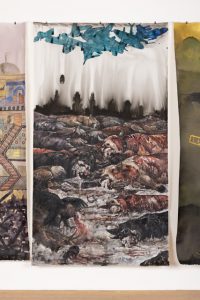
‘The Flood’ by Shwan Dler Qaradaki. Foto: Guttorm Glomsås/Kunsthall 3,14
Two of Shwan’s paintings make that loss visible directly. The first shows a field of dead cattle –several large bulls and cows lying collapsed across a churned, grey-brown ground, some with white foam at the mouth. Vultures and dark birds pick at the bodies in the foreground; the antlers of what looks like a stag carcass are visible off to one side. Above the scene, a thin band of jagged blue-and-white shapes cuts across the top of the painting – fighter jets – with pale drips running down beneath them like a wash of ash. In my interpretation; the cattle stand in for a food source, lying dead everywhere because chemical warfare has made the land and its produce infertile. The land can no longer sustain life.
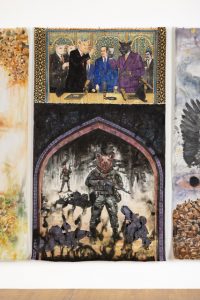
‘The Gulf War Syndrome’ by Shwan Dler Qaradaki. Foto: Guttorm Glomsås/Kunsthall 3,14
The second painting, ‘The Gulf War Syndrome’, traces that poisoning back to where it started. At the top, inside an ornate gold-and-blue patterned border, a group of animal-headed men in suits stand around a table set up like a state signing. Two of the central figures, painted with animal-like heads, are Chirac and Saddam Hussein, according to Shwan, shown mid-handshake and surrounded by several other pig-headed men in dark suits. At the bottom, inside a purple-bordered archway, a soldier with a pig’s head stands in full camouflage holding an assault rifle, with a second armed soldier further back. Shwan explained that this bottom half evokes what is today known as Gulf War Syndrome – a condition that affected tens of thousands of soldiers after the 1990–91 Gulf War and that research has since linked to exposure to sarin nerve gas released when coalition forces bombed Iraqi chemical weapons stores (White et al., 2015; Haley et al., 2022). In his telling, the painting portrays the soldiers as brutal, dehumanized, and without normal empathy, to the point where killing no longer meant much to them.
That same damage is something Shwan has seen with his own eyes, not just painted. He says that when you stand on the border to Iran, you can see a physical difference between the two countries – one side colourful and fertile, the other grey and dead. He remembers Iraq as it used to be; full of life and colour. The people carry the same damage the land does. Beyond the direct toll of war and violence, there is cancer and other illnesses caused by chemical warfare – and there is emigration (Talabani et al., 2018; Ekzayez et al., 2019). Fewer and fewer people are left to practise the culture, heritage, and language.
That is why language becomes a holdepunkt – an anchoring point – and a form of resistance against the erasure of a culture in war. It is what keeps the culture alive when the land and the people who could carry it forward are both disappearing. The same thread runs through all of it: language is identity, and where the language becomes too dangerous to speak, art becomes the language instead.
Click here for Shwan’s Instagram
References
Ekzayez, A., Lillywhite, L., Patel, P., Papamichail, A., & Elbahtimy, H. (2019). Chemical Weapons and public health: assessing impact and responses. Journal of public health. https://doi.org/10.1093/pubmed/fdz145
Haley, R., Kramer, G., Xiao, J., Dever, J. A., & Teiber, J. (2022). Evaluation of a Gene– environment Interaction of PON1 and Low-Level Nerve Agent Exposure with Gulf War Illness: A Prevalence Case–Control Study Drawn from the U.S. Military Health Survey’s National Population Sample. Environmental Health Perspectives, 130. https://doi.org/10.1289/ehp9009
Kirmanj, S., & Rafaat, A. (2021). The Kurdish genocide in Iraq: the Security-Anfal and the Identity-Anfal. National Identities, 23(2), 163–183. https://doi.org/10.1080/14608944.2020.1746250
Talabani, J., Ali, A., Kadir, A., Rashid, R., Samin, F., Greenwood, D., & Hay, A. (2018). Long-term health effects of chemical warfare agents on children following a single heavy exposure. Human & Experimental Toxicology, 37, 836 – 847. https://doi.org/10.1177/0960327117734620
White, R. F., Steele, L., O’Callaghan, J., Sullivan, K., Binns, J. H., Golomb, B., Bloom, F., Bunker, J. A., Crawford, F., Graves, J. C., Hardie, A., Klimas, N., Knox, M., Meggs, W., Melling, J., Philbert, M., & Grashow, R. (2015). Recent research on Gulf War illness and other health problems in veterans of the 1991 Gulf War: Effects of toxicant exposures during deployment. Cortex; a journal devoted to the study of the nervous system and behavior, 74, 449 – 475. https://doi.org/10.1016/j.cortex.2015.08.022
Zeydanlıoğlu,, W. (2012). Turkey’s Kurdish language policy. International Journal of the Sociology of Language, 2012(217), 99-125. https://doi.org/10.1515/ijsl-2012-0051