Anine Lucia Manum, Roos de Ruijter (2026)

Mona Tahani is a visual artist based in Bergen who works in textile, printmaking, painting and wood carving, and also works separately as a cultural worker and drama pedagogue. Identity, migration and memory sit at the centre of her practice, alongside a persistent focus on womanhood, human rights and social justice – topics she approaches through material itself, treating wood, print and paint as a form of research rather than just illustration. Some of that work has been shown in galleries; some of it moves through performance in Norway and abroad (Tahani, n.d.).
Her latest exhibition takes its name, February 28th, from a single date: the day in 2026 when the United States and Israel launched a joint military campaign against Iran (Adler et al., 2026). The title says something about how the exhibition came to exist in the first place. It was her response to the devastating news of war she witnessed from afar, yet its calamity haunted her for days and weeks to come.
In the morning of February 28th, Israel and the United States carried out joint attacks on Iran. This came after negotiations between the US and Iran about the Iranian nuclear and missile programmes. US President Trump announced that the bombings aimed to completely destroy Iran’s missile programme and defend the American people from the ‘threats of the Iranian regime’ (Staff, 2026a; Adler et al., 2026). It was only a few hours later that Iran confirmed that an Israeli strike had hit an elementary school and murdered at least 165 students (Staff, 2026b)
When Tahani heard the news of the February 28th attacks, she was frustrated and helpless, she said. As an Iranian artist who lives in Norway, she felt powerless. Her friends and family still live in Iran, and she was in a constant state of suspension, waiting until she could receive information about events that were out of her control. The project, ‘February 28th’, became a way to transform her feelings of urgency and hopelessness into a material form (Barth, 2026). She carved her artwork into wood, to then use it as stamps on papers she had found of discarded drawings at the kindergarten she works.
At Kunsthallen 3.14, where Tahani had her artwork displayed, she had transformed the small room reserved for her into a place where every part of the wall was covered by one of her paintings. The room, with its walls covered in art that showed despair, dark colours, and jagged edges, gave you an unsettling feeling. To the viewer, the art installation conveys a compulsive, frantic, and obsessive energy. The inability to stop creating this art due to the need to get it all out on paper.
Art has long carried a particular weight in Iran and has played a central role in several movements in the country. Through the 1979 revolution, the years that followed, and, more recently, the Woman, Life, Freedom movement. Art has been used as the mouthpiece to convey a message that otherwise could not be said aloud. Read more about this here.
Tahani was born in 1982, a few years into the new republic, and one year before the enforcement of the mandatory hijab in the country. From early on, she was fascinated by the female body, and she started drawing it before she had any language for why. She remembers holding her drawing in one hand – depicting her illustration of the female body and breasts – while also hearing and seeing what was displayed on the television; everything the revolution and its aftermath had set in motion. The world around her treated the female body as something dangerous, something to be covered and controlled – and yet what she felt looking at her own drawings was nothing like that. She couldn’t reconcile the two. Underneath that larger contradiction was a smaller, more immediate one: who could she even show these drawings to? Would it be safe?
The female body stayed a central part of her work, and February 28th carried the same preoccupation into a full exhibition. The room was filled with female bodies – painted, printed and worked into wood. Walking through it, the feelings that arose were not subtle. It conveyed hopelessness, dark in a way that didn’t offer much relief; it gave the viewer a sense of how war only produces suffering, and not much else. The point was underlined by the words “Say No to War,” which recurred throughout the entire exhibition.
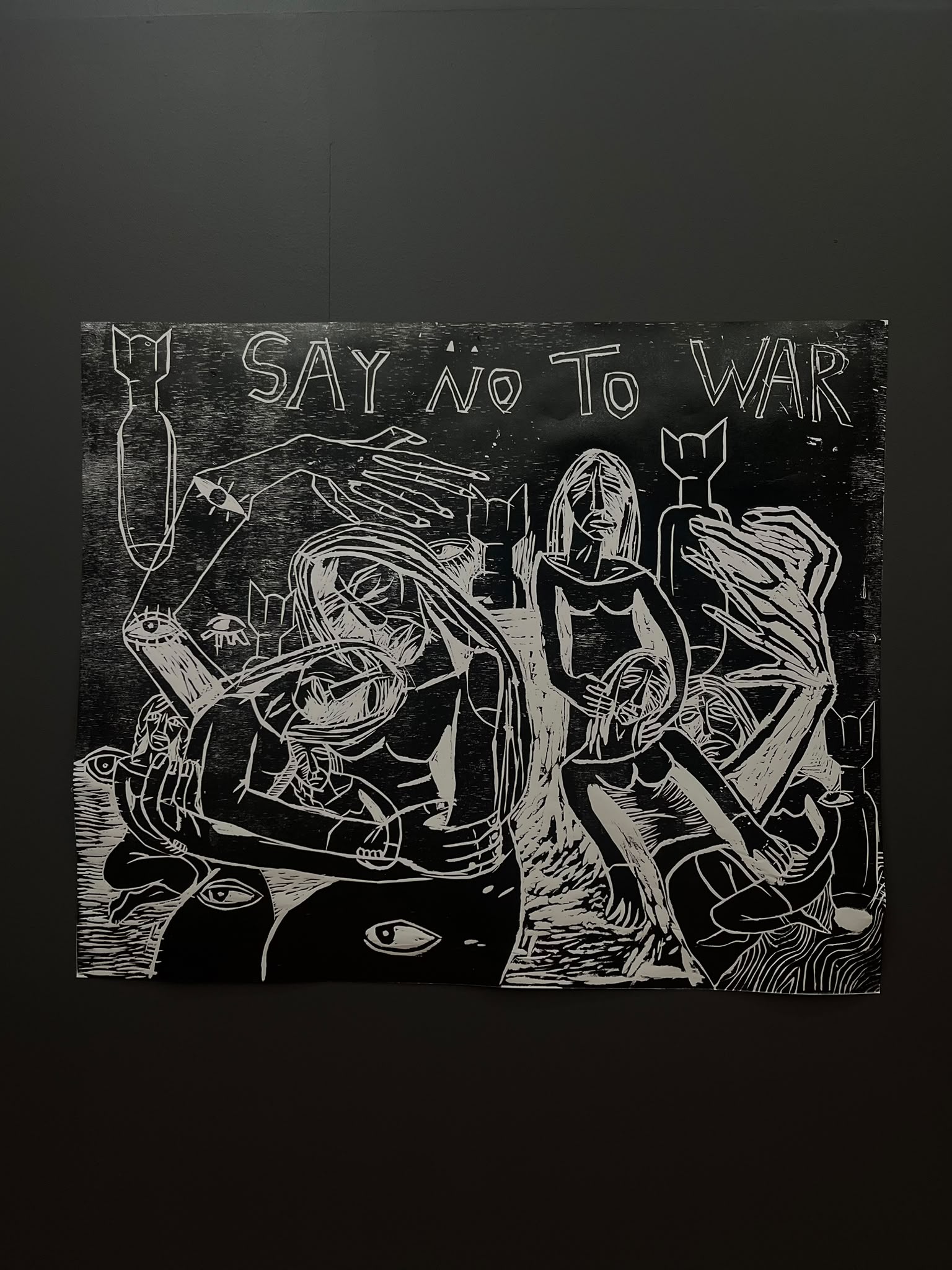
‘You can feel how I felt when touching my project’, Tahani says of the work.
In the middle of the exhibition, a single wooden plate hung alone on one wall; painted black, cut through with carvings. It is the plate she worked from. When the acts on February 28th happened, she was filled with a feeling of hopelessness about not being able to do anything from so far away, and making it was how she consoled herself. She picked up the carving tool and worked through the night until she couldn’t anymore. That continued, night after night, until it had produced 400 prints and 15 handmade artist books – her entire response to a war she could only watch.
The carving itself shows its process on the surface: every mark is a place where the black paint has been cut away to expose the wood underneath, scarred and pale where the black has been carved out. Her technique reflects that faithful night: working through the dark, cutting into the wood, until something lighter shows through underneath. The exhibition was able to do two things at once: it illustrates exactly what Tahani felt on February 28th and in the weeks after, and it allowed people to feel that directly without it needing to be explained.
As Tahani said: we usually go to museums to tell the history of that moment, and this is her moment. Her art conveys something universal about who we are as human beings in this world; something that treaties and peace agreements are unable to convey.
Click here for Tahani’s Instagram
References
Adler, N., Stepansky, J., Marsi, F., Mohamed, E., Pietromarchi, V., Siddiqui, U., Milisic, A., Regencia, T., Magee, C., Everett, M., Uras, U., & Hancock, A. (2026, March 2). US, Israel attack Iran updates: Khamenei, top security officials killed. Al Jazeera. https://www.aljazeera.com/news/liveblog/2026/2/28/live-israel-launches-attacks-on-iran-multiple-explosions-heard-in-tehran
Barth, M. (2026). Mona Tahani – February 28th. Kunsthall 3,14. https://www.kunsthall314.art/mona-tahani-28-februar
Staff, A. J. (2026, February 28). Why are the US and Israel attacking Iran? What we know so far. Al Jazeera. https://www.aljazeera.com/news/2026/2/28/us-and-israel-attack-iran-what-we-know-so-far
Staff, A. J. (2026b, March 1). Death toll in Israeli strike on southern Iran school rises to 165. Al Jazeera. https://www.aljazeera.com/news/2026/2/28/israel-strikes-two-schools-in-iran-killing-more-than-50-people/
Tahani, M. (n.d.). CV. Mona Tahani. https://monatahani.wordpress.com/cv/
Foto’s: Julie Sofie Svenkerud & Roos de Ruijter