Anine Lucia Manum, Roos de Ruijter (2026)

On Thursday, August 20th, a group of researchers, scholars, and students gathered at Kunsthall 3, 14 to learn about and discuss art as a form of resistance. Alicia Ely Yamin opened the panel by discussing her Argentinian background. Due to the dictatorship in Argentina, Alicia grew up in the United States with her Argentinian mom, who was very present in the art world. As a child, her mother would bring her to exhibitions and art shows that promoted Latin American art, but she was too young to really ask the artists the right questions and to understand what everything meant. Now, looking back, she can see how this art was used as a form of resistance.
After Alicia’s introduction, Mona Tahani and Shwan Dler Qaradaki elaborated on their background and explained how their art represents their feelings about colonial repression, assimilation, and erasure. Read more about Tahani’s exhibition about the United States’ and Israel’s invasion of Iran here. Read more about Shwan’s exhibition about Iraq and Kurdistan here.
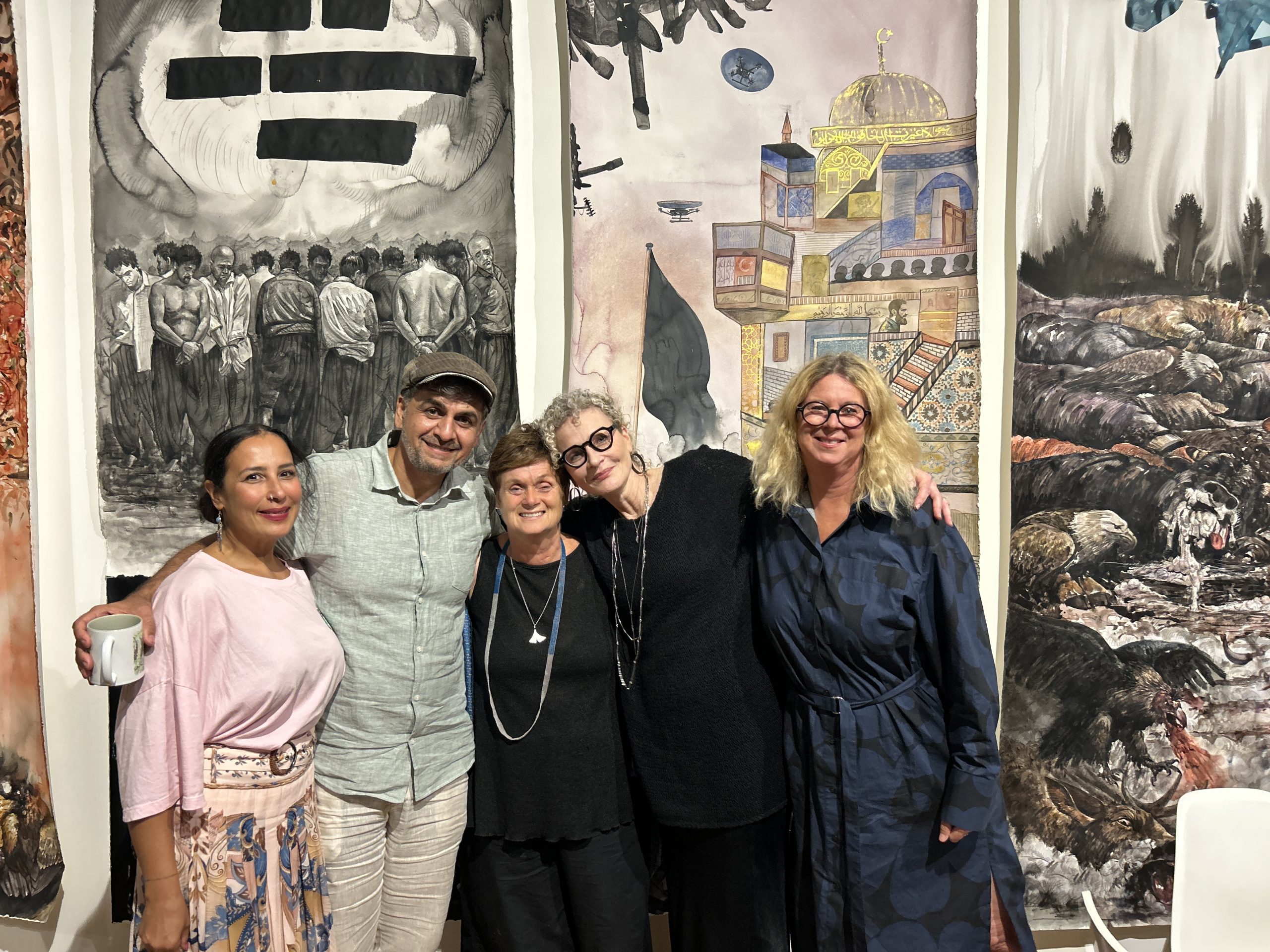
Left to right: Mona Tahani, Shwan Dler Qaradaki, Siri Gloppen, Alicia Ely Yamin, Malin Barth
The second part of the panel introduced new perspectives – about the Iranian Revolution, Norwegian Sámi, and the December Revolution.
Iran: Woman, Life, Freedom
Ali Teymoori opened up the second part of the panel by discussing the Woman, Life, Freedom movement. In Iran, the Woman, Life, Freedom movement became a powerful symbol of resistance after the death of 22 year old Mahsa Jina Amini, who died in police custody after being arrested by Iran’s ‘morality police’ after failing to properly cover her hair (womanlifefreedom.today, n.d.). What began as a protest against the death of an innocent young girl turned into a movement across all of Iran that challenged decades of oppression and gender-based violence (Amnesty International, 2022). Ali explained that though the protests were met with repression, the movement spread quickly and reached more than 140 cities in the span of 3-4 days. A big part of what is keeping the movement alive and what allowed it to spread so quickly was the use of art. For example, the song ‘Baraye’ is a protest song written by Iranian songwriter Shervin Hajipour, with its lyrics based on tweets posted by Iranians that list the reasons why they are partaking in the protests (Rajvanshi, 2023).
Norway: Sámi People’s Resistance
The Sámi people in Norway faced a different kind of oppression. As Elin Skaar put it: the Sámi people were not met with bullets and executions, but rather with the forced repression of their cultural identity. Elin reflected on her own privileged position and on learning about Norway’s colonial history later in life. In 2023, the Norwegian government published a report of over 700 pages that described the forced assimilation and cultural genocide committed against the Sámi people (Staalesen, 2023). For example, indigenous songs were demonised, as they were not considered to be Christian. By taking back their language, their clothing (the kofte), and their songs (yoiks), the Sámi people showed political resistance and opposition towards politicians. According to Elin, the Sámi identity has become more present in different spheres, especially with young people.
Sudan: the December Revolution
Issraa Elkogali Häggström spoke about how for her, art is connected to memory and identity. She mentions the Sudanese revolution from 2018-2019, and how the repression of it did not end with physical violence but rather with a removal of its visual presentation. During the revolution, also called the December Revolution, murals and graffiti actively contributed to its narrative and trajectory (Bahreldin, 2025). After the revolution, public art that had been given to the city was being removed. Walls that had served as murals and political statements were painted over. This way, Issraa said, the physical memory of the revolution was attempted to be erased. However, videos and recordings continued to exist, and poetry continued to be recited.
Art as the Mouthpiece
This panel was part of the 2026 Bergen Exchanges, in collaboration with Kunsthall 3,14. It brought a different perspective, as we got to talk to people living through the realities we had been discussing throughout the week. Additionally, we got to see how art can be used as an instrument to resist autocratisation, and how oppression is felt even outside of the violent context. How war creates a lasting impact even many years after you are ‘safe’, and how the artists used art to express this impact directly on their canvas. The art therefore becomes the means of action with which the artist gets to both express their own trauma, pain, and oppression, as well as an instrument to demonstrate and mobilise against oppressive regimes.
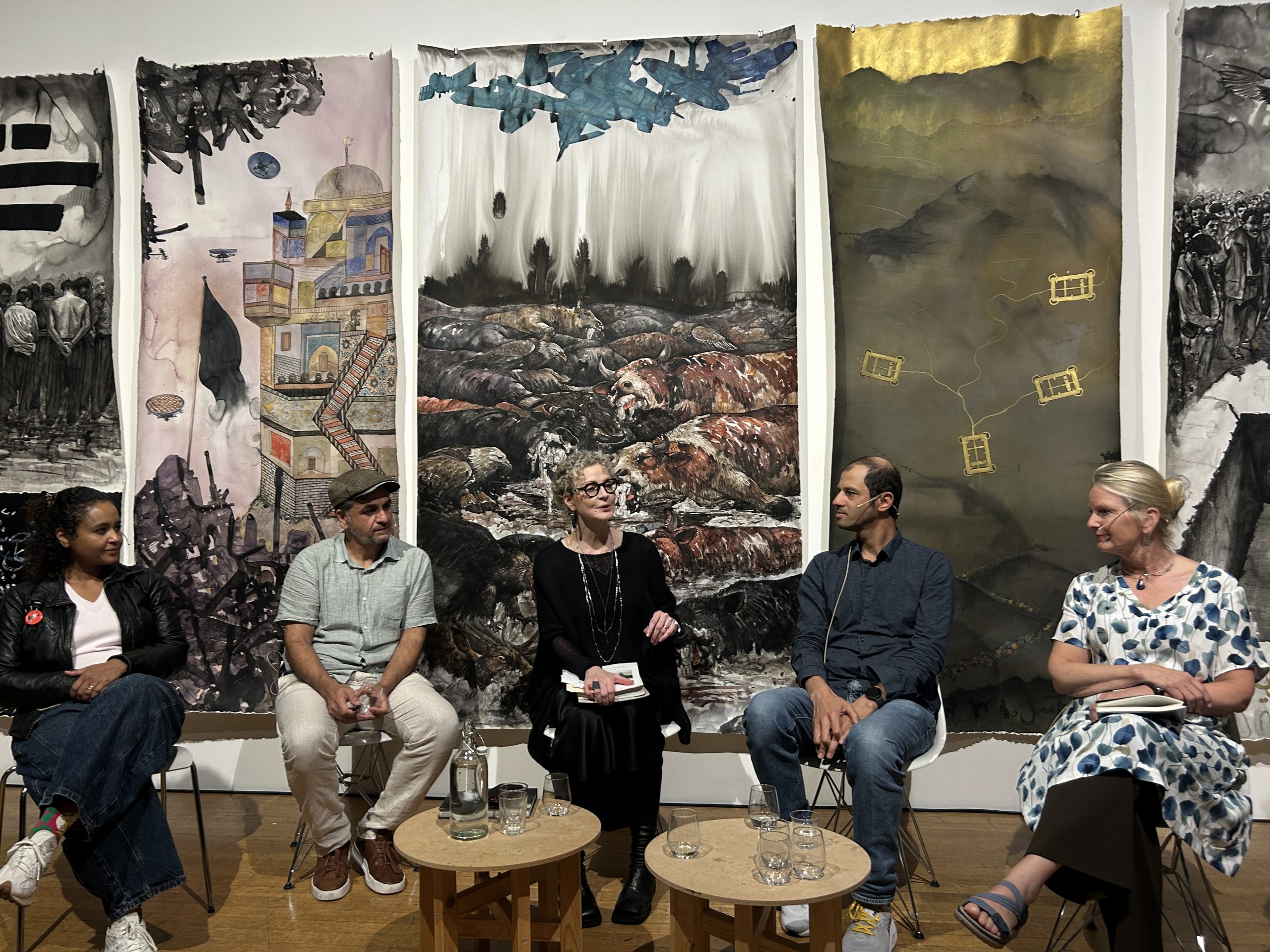
Left to right: Issraa Elkogali Häggström, Shwan Dler Qaradaki, Alicia Ely Yamin, Ali Teymoori, Elin Skaar
References
Amnesty International. (2024, December 10). Iran: Two years after ‘Woman Life Freedom’ uprising, impunity for crimes reigns supreme. https://www.amnesty.org/en/latest/news/2024/09/iran-two-years-after-woman-life-freedom-uprising-impunity-for-crimes-reigns-supreme/
Bahreldin, I. Z. (2025). Walls of change: the role of public art in shaping khartoum’s 2019 sit-in space. Journal of Umm Al-Qura University for Engineering and Architecture, 16(4), 962–976. https://doi.org/10.1007/s43995-025-00129-w
Rajvanshi, A. (2023). Why Iran’s Unofficial Protest Anthem ‘Baraye’ Won a Grammy. Time. https://time.com/6253188/iran-grammys-shervin-hajipour/
Staalesen, A. (2023, June 2). Norway’s injustice against minorities laid out in new landmark report. Thebarentsobserver. https://www.thebarentsobserver.com/indigenous-peoples/norways-injustice-against-minorities-laid-out-in-new-landmark-report/133029
womanlifefreedom.today. (n.d.). Open Letter on Iran. Woman, Life, Freedom. https://www.womanlifefreedom.today/
Foto: Julie Sofie Svenkerud