
Julie Sofie Svenkerud (2026)
Amazomania: Who Gets to Decide What the Images Mean?
In Amazomania, Swedish director Nathan Grossman revisits footage from a 1996 expedition into the Javari Valley, Brazil to contact a group of Korubo people for the first time. The film moves from the original recordings to journalist Erling Söderström’s return around thirty years later, when the Korubo explain how they experienced the encounter. Their accounts change our understanding of what the cameras recorded.
Before the screening, I attended a panel discussion with Rachel Sieder and Ana Carolina Alfinito 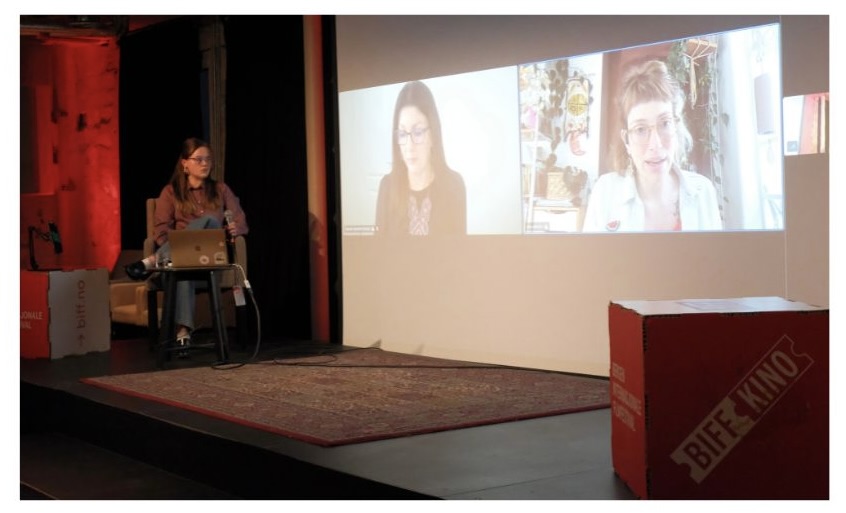 Vieira, both involved in the PluriLand research project. Their perspectives on Indigenous land rights, self-determination and representation shaped how I watched the film. One question stayed with me: who gets to decide what should be filmed? Documenting an encounter can help draw attention to people who need protection, but it can also expose them in a vulnerable situation. How much say do the people in front of the camera have in deciding what is recorded and shared?
What Does “Contact” Actually Mean?
During the panel, Ana Carolina made an important clarification: isolation does not mean that the Korubo had never encountered outsiders. They already had experiences with rubber extractors, fishermen and others taking resources from their territories. These encounters could bring disease, violence and the loss of their livelihoods. There are several groups with different experiences and relationships with the outside world, so the group we follow in thefilm does not represent all Korubo people. Ana Carolina pointed out that the word “contact” is neutral and can hide very unequal relations of power. It tells us nothing about who approaches whom, whether the encounter is wanted, or whether either side can withdraw. She described how Korubo attempts to defend their territory could be met with much more forceful retaliation.
This makes the idea of “first contact” in the movie more complicated than it initially seems. For the journalists, the encounter could appear to be a discovery. For the Korubo, it was part of a longer history of outsiders entering their land. Knowing this makes the suspicion and resistance we see in the film easier to understand. Without this background information, people defending themselves can easily appear to be a threat to those arriving from outside.
There is a scene involving a drink that shows why this matters. What initially appears to be hospitality takes on a different meaning when a Korubo representative later explains that the drink offered to the visitors was poison. The camera recorded the action, but its meaning changes when the people being filmed get to explain it themselves.
Documenting to Protect
My impression is that the expedition leader, Sydney, wants to protect the Korubo. Still, I question the number of journalists taking part and how much space filming takes up during the encounter. Who is this documentation mainly for? Where is the line between making people visible and turning them into a sensation?
The struggle over Korubo territory and violence, which was the background of the expedition, makes these questions harder. Ana Carolina explained that documenting the presence of Indigenous peoples could be used to pressure the state to protect their land. If outsiders denied that they existed, it could become easier to ignore both them and their claims. The filming could therefore have a purpose beyond showing the encounter to an audience.
But visibility does not guarantee protection. Rachel explained that legal rights give people a way to challenge abuses and demand action from the government. Still, the authorities need to commit resources and act on these obligations for the rights to make a difference. She used the Fosen case to show that even after winning in court, people may still have to fight for the ruling to be followed. Documenting the Korubo’s existence could therefore help them demand protection, but it could not, by itself, keep their land safe or ensure that they could decide over their own lives.
This is one of the film’s most difficult dilemmas. The documentation could contribute to protection while involving people who did not necessarily want contact. A protective purpose does not settle the question of how the encounter was carried out, or how much influence the Korubo themselves had over it.
Rachel stressed that Indigenous peoples have always told their own stories. The problem is that outsiders’ accounts have often held more power. She argued that decolonial collaboration requires time, listening and influence over both the questions being asked and how the material is presented. For me, this connects protection and representation: self-determination must also include being heard when explaining your own experiences. I see a step in this direction in the second part of the film. The anthropologist appears to have a longer relationship with the Korubo, and several people are given time to explain their experiences without being rushed. They have space to challenge the story previously told about them and help explain what we are seeing.
How Far Does the Film’s Self-Criticism Go?
Still, I do not think the film fully moves beyond the perspective it tries to criticise. Erling remains a central figure in the second part. We meet him at home and follow his return and his reactions to what has happened. This can be a relevant approach in a film about journalistic responsibility, but I found myself wanting more of the context discussed in the panel.
Rachel described colonisation as an ongoing process involving extraction, displacement and control over land. She also discussed how demand for minerals and energy creates new pressures, including through the growth of data centres. This was a broader point about resource demands and Indigenous territories, rather than a specific claim about the Korubo’s land. It nevertheless made me more aware of how little the film tells us about the pressures surrounding their lives today.
I wish Amazomania spent more time on their current situation and how their lives have changed since the encounter. When so much space is given to the journalist confronting his own past, I find the film’s self-criticism limited. The Korubo get to correct the story and tell some of their own, but Erling’s experience still largely determines how the film is put together.
Freedom, Images and Responsibility
Early in the second part, in his home in Sweden, Erling admires what he sees as the Korubo’s freedom from capitalism and dependence on money. Later in the Korubo village, a woman tells the children to sell handicrafts to him. Selling goods and depending on monetary values do not mean that the Korubo have lost their freedom, but the scene challenges his idea of what their freedom consists of. Perhaps his expectation that they should live outside the economy also makes it harder for him to understand their demands.
This becomes clearer in a discussion on compensation, including a request for a boat for the filming in the new footage. Later, Erling emphasises that he spent all his money on equipment, so he claims he has the right to the documentary, while the Korubo point to the people in the images, including deceased family members. I feel that they are talking past each other.
His investment does not answer their concerns about others controlling and continuing to use these images. Their demands also show an attempt to regain influence over the footage and its value. This connects with Ana Carolina’s discussion of Indigenous peoples actively asserting their rights. The scene feels unplanned and somewhat chaotic, which makes me wonder whether compensation and rights to the old footage would have been discussed at all in the new film if the Korubo men taking the crew to and from the village had not raised it themselves.
Consent is another concern. We hear that some Korubo thought the camera was a weapon during the first encounter. A shared understanding of filming therefore cannot be assumed. Did they understand that the images could circulate the world and be used decades later? Would they have agreed if they had known?
We cannot answer these questions with certainty. In my view, the journalists nevertheless have a responsibility to give the Korubo access to the material, a meaningful say in its future use, and a serious response to their demands for compensation.
Could It Have Been Done Differently?
Ana Carolina’s explanation of documentation as a means of demanding protection makes it difficult to dismiss the expedition as simply unnecessary. We cannot know what would have happened without it. But its possible benefits do not establish that this particular approach was necessary. Could it have involved fewer journalists or greater respect for the Korubo’s wish to keep their distance?
While watching the film, I thought about the question: “If a tree falls in a forest and no one is around to hear it, does it make a sound?” For me, this brought up the violence that could take place without attracting attention beyond the communities experiencing it. Ana Carolina described how outsiders could deny the presence of Indigenous peoples on land they wanted to exploit. If even their existence could be denied, how could their experiences reach the authorities and lead to protection? This comparison is limited. The Korubo were there. They experienced the violence and losses whether outsiders acknowledged them or not. Their experiences did not become real when a journalist arrived with a camera. Documentation could, however, make it harder for others to deny the Korubo’s existence.
Rachel’s point that Indigenous peoples have always told their own stories is important here. Why should an outside journalist’s images carry more weight than the accounts of those who live there? The need for documentation reveals something troubling about whose knowledge is trusted and what it takes to make the state respond.
Amazomania changes how we understand the old footage by allowing the Korubo to challenge it. Yet Rachel’s account of decolonial collaboration also asks more of the new film: how much influence do they have over the questions and the story being told? By the end, I wanted to know more about their lives now and what they wanted the world to hear, beyond their response to Erling’s return.